AI Automation Agency: What They Do, What They Cost, and How to Choose One (2026 Buyer’s Guide)
An AI automation agency helps businesses automate repetitive, time-consuming work using artificial intelligence, workflow automation, and connected business systems. Instead of manually handling tasks such as lead follow-up, customer support, document processing, data entry, scheduling, or reporting, businesses can use automated workflows to handle much of that work faster and more consistently.
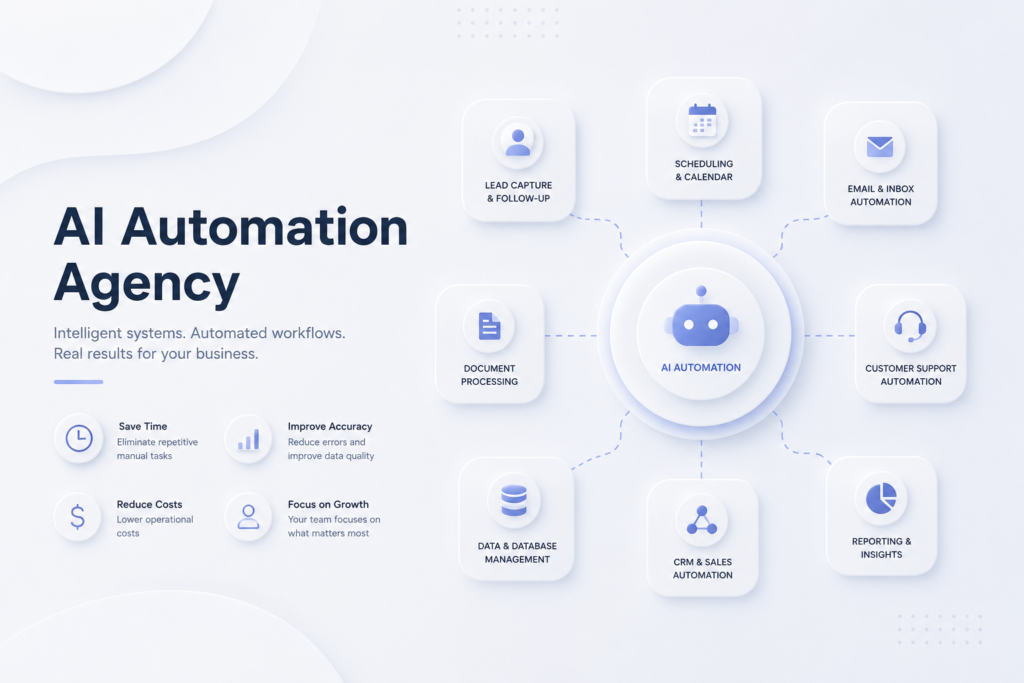
For a business owner, the real question is not whether AI can automate a task. It is whether an automation agency can identify the right processes to automate, connect the systems you already use, and build workflows that deliver measurable business value.
What is an AI automation agency?
An AI automation agency builds and runs automated systems for other businesses — systems that lean on AI to take over repetitive or language-heavy work. Customer intake, lead follow-up, document processing, support triage, scheduling, reporting: that kind of thing. The difference from buying software is that a software company sells you a login and wishes you luck. An agency maps the workflow, wires up your tools, builds the automation, and hands you something that actually works.
That’s the short answer. The more useful one starts with understanding what the “AI” part is doing, because “automation” covers a lot of ground and the differences change what you should pay and expect.
AI automation vs. traditional automation vs. AI agents
Most agencies work across three tiers, and knowing which one your problem needs will save you both money and frustration.
The first is plain rule-based automation — fixed “if this, then that” logic. It’s fast, cheap, and reliable, right up until the inputs change, at which point it falls over. Moving a form entry into your CRM is a good fit. Reading a messy email is not. This is classic workflow automation and RPA, and it doesn’t really need AI at all.
AI-powered automation is where the label earns its keep. Here a language or vision model handles inputs that vary — classifying a support ticket, pulling fields out of a non-standard invoice, making sense of an email that doesn’t follow a template. Rules alone can’t cope with that kind of variation, which is exactly why this tier exists.
Then there’s agentic automation, the newest and least settled of the three. An AI agent plans and carries out a multi-step task on its own — take an inbound lead, research it, draft a reply, book the call — deciding what to do at each step. It’s genuinely useful and still early. McKinsey’s 2025 survey found 62% of organizations experimenting with AI agents but only 23% scaling them in even one function, which tells you roughly where the technology sits: promising, not yet mature.
A good agency starts from your problem and reaches for the lowest tier that solves it. If someone pitches an autonomous agent for something a simple rule could handle, that’s worth a second look.
What does an AI automation agency actually do?
The specifics differ from shop to shop, but the core tends to include:
- Process discovery and an automation audit — finding where the manual time and the errors actually live before building anything.
- Workflow automation — connecting your existing tools so data moves without anyone copying and pasting, whether that’s built on Zapier, Make, n8n, or custom code.
- AI agents and assistants — support agents, sales-intake agents, or an internal “ask the knowledge base” assistant.
- Document and data automation — extracting information from invoices, contracts, and forms, then classifying or enriching it.
- CRM, sales, and marketing automation — lead capture and qualification, follow-up sequences, and keeping the pipeline clean inside HubSpot, Salesforce, and similar systems.
- Customer-service automation — triaging tickets, handling first-line responses, and routing, with a clear path to a human when needed.
- Integration work — the unglamorous plumbing that makes all of the above possible.
- Maintenance — monitoring, fixing what breaks, and tuning as your tools and volumes shift.
Two things vary a lot between agencies, and they’re worth pinning down early: whether they build custom systems or slap your logo on someone else’s platform, and whether they stick around to maintain what they build or hand it over and disappear.
What can — and can’t — an AI automation agency automate?
The tasks that automate well share a profile. They’re repetitive, they happen often, they follow a recognizable pattern, and they’re either eating real hours or causing costly mistakes. Lead follow-up, scheduling, invoice and document processing, syncing data between systems, support triage, routine reporting — these are the usual first wins.
The poor candidates are the mirror image, and there’s a practitioner rule worth respecting here: be careful about fully automating anything high-stakes, high-judgment, or relationship-driven. Sensitive customer conversations, real negotiations, anything legal or compliance-related — that’s territory where the human is the point. Low volume works against you too. If a task happens a handful of times a month, or every case is genuinely one of a kind, the math usually doesn’t hold up. And automating a broken process just means you now do the wrong thing faster.
This is where the honest numbers matter. Adoption is nearly everywhere — McKinsey reports 88% of organizations now use AI in at least one function, up from 78% a year earlier — but measurable financial impact is still rare. Only about 39% report any enterprise-level EBIT effect, and roughly 6% qualify as high performers. A separate MIT Project NANDA study put it more bluntly, finding that around 95% of enterprise generative-AI pilots delivered little to no measurable return to the bottom line. None of that means AI doesn’t work. It means the results come from choosing the right workflow and running it reliably in production, not from adopting AI because everyone else is. Closing that gap is, in theory, the whole job of a good agency.
Hire an agency, build in-house, or just buy software?
Hire an agency when you need to move quickly, you don’t have senior automation talent on staff, and you want a defined scope — particularly when you’re trying to prove automation will pay off before you commit to a full-time hire. Build in-house when automation is central to how the business runs and you’ll have a steady stream of it. And for a single, well-defined task, an off-the-shelf tool or a freelancer is usually all you need.
Here’s a rule you can run through in a couple of minutes:
- A one-off, well-defined task → buy the software, or hire a freelancer. Don’t pay for a team you don’t need.
- Several connected workflows that have to run reliably, with no automation engineers in-house → an agency.
- Automation is core to how you make money, with a constant backlog → build in-house, often after an agency ships the first version.
A sensible middle path shows up a lot in practice: bring in an agency for the first two or three builds, then hire one person in-house to maintain and extend them. The cost comparison is straightforward — a senior US automation engineer runs roughly $90,000 to $200,000+ a year fully loaded, so a $3,000–$5,000 monthly retainer is often cheaper than a hire until your volume justifies the salary.
How much does an AI automation agency cost?
Most engagements land somewhere between $5,000 and $75,000 for a project, or $2,000 to $15,000 a month on retainer, with hourly work usually in the $100–$300 range. Where you fall comes down to scope, the state of your data, and how many workflows you’re automating. Hardly any agency publishes these figures, which is why the ranges below are more useful as a gut check than a price list.
| Pricing model | Typical market range (2026) | Best for |
|---|---|---|
| Discovery / audit | $0–$5,000 | Scoping before you commit to a build |
| Single scoped workflow | $1,500–$25,000 | Automating one expensive, repetitive process |
| Multi-workflow / project build | $25,000–$100,000+ | Connected systems across several tools |
| Enterprise / agentic systems | $100,000–$250,000+ | Full-stack, multi-agent deployments |
| Monthly retainer | $2,000–$15,000 | Ongoing builds, monitoring, and tuning |
| Hourly | $100–$300 | Exploratory or undefined scope |
These are ranges drawn from across the market in 2026, not a fixed standard — your actual quote will move around them.
Two patterns are worth carrying into any pricing conversation. First, the biggest cost driver is usually integration complexity, not how long the workflow is. Connecting five finicky systems costs more than a long automation living inside one tool. Second, a hybrid arrangement — a fixed fee for the first defined build, then a smaller monthly retainer to keep it running — has become the common default, because it dodges both the scope creep of pure project pricing and the pay-for-nothing risk of a pure retainer.
For most small and mid-sized businesses, the smart move is to automate one expensive, repetitive process with AI automation services in the $5,000–$25,000 range, measure what it actually saved, and decide from there. Any agency that wants a long commitment before scoping real work is a reason to slow down.
How to choose an AI automation agency.
The market filled up fast, and the websites all blur together — “intelligent agents,” “automated workflows,” “guaranteed ROI.” The differences that matter sit underneath that copy, and the same handful of questions separate the teams that ship working systems from the ones that ship demos.
Ownership and exit terms. Do you end up owning the source code, the prompts, the configurations, the documentation, and the credentials — all built inside your own accounts? A strong partner transfers full ownership. An agency that keeps the system locked in its own environment with no way out is a serious red flag.
Security and data handling. Where does your data live? Is any of it used to train models? Can they meet whatever your industry requires — HIPAA, GDPR, and so on? In regulated work especially, the right partner talks about your data and your risk before they talk about their tools.
What happens when the AI is unsure. There should be a clear escalation path and a human review step, not the system quietly guessing and hoping.
Proof, not logos. Ask for case studies with real, measurable outcomes and the context behind them, plus a reference you can actually call. A small paid proof-of-concept on your own data before a big build is often worth it.
Custom or reseller. Is this built for you, or a white-labeled platform with your name on it? If every client demo looks identical, that tells you something.
Pricing and scope in writing. A fixed price tied to an outcome, with change requests quoted before the work starts, beats open-ended time-and-materials for most buyers.
A maintenance plan. AI systems drift — prompts degrade, APIs change, your business changes. Find out who owns monitoring and fixes after launch, and what that costs.
They lead with your workflow, not their stack. A good agency will even tell you when you don’t actually need them. If the answer to “could we do this with something we already have?” is always “no, you need us,” stay skeptical.
The fastest way to actually compare shortlisted agencies is to hand two or three of them the same real, sanitized problem and watch how they scope it — the security model, the human-review design, the ownership terms, the price tied to an outcome. How they think through your problem tells you far more than any polished demo.
What implementation usually looks like
Most engagements move through a recognizable set of stages:
- Discovery and scoping — mapping the process, agreeing on what success means, confirming integration’s. Get a baseline down here: current time spent, error rate, cost per transaction. Skip it and “ROI” becomes a story instead of a number.
- Design — settling on the automation tier, the tools, and where humans stay in the loop.
- Build and integration — the actual construction and the connections to your systems.
- Testing — including how it behaves on messy, edge-case inputs, not just the clean path.
- Deployment and handover — going live, with documentation and ownership transferred to you.
- Maintenance — monitoring and tuning over time.
Timelines follow scope. A single, well-defined workflow — email triage, a booking flow, document processing — is often a few weeks of work. Multi-system builds take longer. Anyone promising a full transformation in days is showing you a demo, not a production system.
The risks worth taking seriously
The build is only half the job. A system nobody maintains tends to break within months, so budget for upkeep from the start. There’s also a data question that’s easy to overlook: every prompt sent to a cloud model is data leaving your walls, and for sensitive records you’ll want to ask about self-hosting or clear data-handling guarantees up front.
Over-automation is its own trap. Push AI into judgment-heavy or relationship-critical work and you chip away at the very thing your customers value. Lock-in is another — if you don’t own the code and it doesn’t run in your accounts, you’re renting something the vendor can reprice whenever they like. And treat “guaranteed ROI” with no measurement behind it as a warning, not a selling point. Real value shows up as hours saved, errors cut, or revenue moved, measured against a baseline you set before the work began.
So, is it worth it?
It depends on the fit, and a little skepticism is healthy given how much noise surrounds the term. An agency earns its fee when you’ve got a genuinely repetitive, costly process, you don’t have the in-house expertise to automate it well, and you want a working result without hiring for it. It’s a poor fit when the need is a single task a cheap tool already covers, when the process is too variable or too low-volume to justify building anything, or when the real reason you’re buying is that AI is everywhere and you feel behind. Start small, measure honestly, and let the evidence decide how far you take it.
FAQ
What is an AI automation agency?
It’s a specialist firm that designs, builds, deploys, and maintains AI-powered systems that take over repetitive or language-heavy work — lead follow-up, document processing, support triage, and the like. Instead of a software login, you get a scoped, built, and integrated system that runs.
What does an AI automation agency do?
It audits your processes to find work worth automating, builds the automations or agents, connects them to the tools you already use, tests them, hands over ownership, and in most modern engagements maintains and tunes them over time.
How much does an AI automation agency cost?
Most engagements run about $5,000–$75,000 per project or $2,000–$15,000 a month on retainer, with hourly work around $100–$300. Simple single-workflow builds can start near $1,500–$5,000; enterprise, multi-agent systems can top $250,000. These are 2026 market ranges, not fixed prices.
Is an AI automation agency worth it?
It’s worth it when you have a repetitive, costly process, lack in-house automation skills, and want a reliable result fast. It’s not worth it for one-off tasks a cheap tool handles, for very low-volume or highly variable work, or when the motive is hype rather than a specific problem.
How do I choose an AI automation agency?
Confirm you’ll own the code and data, built in your own accounts. Check how they handle security and data, insist on a human-review path, ask for measurable case studies and a reference, prefer fixed pricing with a written scope, and find out who maintains the system after launch. Testing two or three agencies on the same sanitized problem is the quickest way to compare them.
What’s the difference between an AI automation agency and an AI consulting company?
Consulting firms tend to advise — strategy, roadmaps, readiness. Automation agencies build and run the actual systems. Some do both, but the practical question is whether you walk away with a slide deck or a working workflow.
What’s the difference between AI automation and traditional automation?
Traditional automation follows fixed rules and breaks when inputs change. AI automation uses language or vision models to handle variable, unstructured inputs — messy emails, mixed tickets, non-standard documents — that rules alone can’t process.
How long does implementation take?
A single, well-defined workflow is often a few weeks. Bigger builds spanning several systems take longer. Treat “live in a few days” as a demo, not a production-ready system.
Should I hire an agency or build in-house?
Hire an agency to move fast, when you lack senior automation talent, or to prove out ROI before adding headcount. Build in-house when automation is core to the business with a steady pipeline of work. A common route is to have an agency build the first versions, then bring one person in-house to maintain them.